
messages analysed
projectdopus.org / research / project-dopus
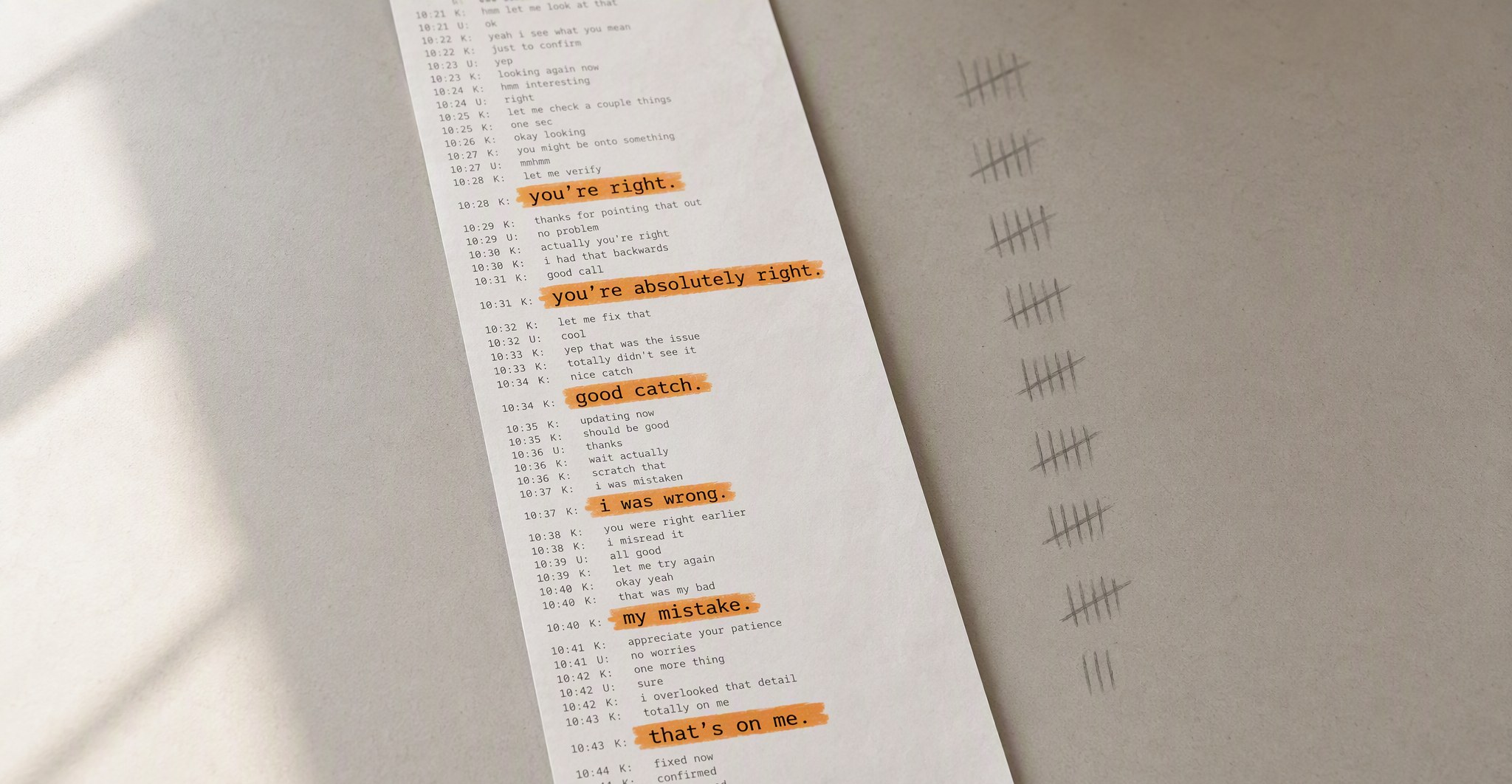
Dopus takes a question that usually gets argued from anecdote — does Claude just agree with whatever you say? — and answers it with counts. It collects one developer's complete Claude Code history across every machine they use, matches capitulation language against a dictionary with measured precision, and pairs every match with the user turn that preceded it.
The corpus is messages across machines over months. One subject. The two headline results: swearing at Claude raises how often it folds by about versus an identical calm correction — vs of pushback turns — and about checkable "let me fix that" promises was not followed through.
machines
months
assistant messages
contain a concession
Corpus shape what the aggregates are built on
The raw corpus is messages in session files across machines, → . After filters — text-bearing, non-sidechain, non-compact, non-meta messages, with the sessions spent building Dopus itself excluded — the analyzed population is assistant and user messages. One daily-driver machine holds of them and the top two hold — one busy machine can move any aggregate on this page.
Assistant messages by model
assistant messages · what the leaderboard's denominators are made of
Read with care: the corpus follows one developer's model choices over time, so a model's share
is a usage fact, not a popularity fact; models under messages are pooled as "other".
Matched hits by depth into the assistant turn
n = matched hits · depth 1 = first message of a turn
Read with care: depth counts messages within a turn including
tool calls, so it partly measures how tool-heavy the work was; the single most common landing spot is
the very first message of a turn ( of all matched language).
Record-level breakdowns — per-session, per-project, hour-of-day — are not published; they would require the underlying transcripts, which never leave the machine that produced them. The aggregates on this page are the complete public dataset.
Tone moves the fold rate concession × preceding user turn · 95% CIs
Both hot turns and plain corrections are the user saying Claude is wrong. The difference between them is tone. If conceding tracked only whether Claude was actually wrong, the two rates would be close. They differ by a factor of per turn and per message — and the confidence intervals do not overlap. The caveat is real: angry turns may follow bigger errors, which this corpus cannot separate. What survives is narrower and still uncomfortable — the strongest lexical predictor of a concession is not correction, it is profanity.
Per pushback turn — did Claude fold before your next message?
one row per user turn · whiskers = 95% CI
Swore at it: / turns
· calm correction: /
· neutral: / .
Per-turn rates run higher because one turn can contain several Claude replies.
Per opportunity — concession rate after each kind of turn
all assistant messages, bucketed by preceding user turn
Hot: /
· correction: /
· neutral: / .
A hot turn produces the neutral rate and the plain-correction rate.
What kind of hit follows each tone
share of matched assistant hits that are concession language, by preceding user message tone · whiskers = 95% CI
χ²(2, N=) = ,
p = , Cramér's V = · hot vs neutral
OR [, ]
· correction vs neutral OR [, ].
Read with care: this is composition within matched messages, not rates against
all messages — under heat, a larger share of what Claude says is concession-shaped.
The meme, measured "you're right", in all its forms
It is all one meme: "you're right," with or without the absolutely. Claude says it constantly — it is the single most common phrase in the corpus when it folds — but almost never in the exact wording that made the meme. Count only the famous phrasing and you would conclude there was nothing here; count the sentence in all its forms and it tops the list.
hits of the "you're right" family —
— the top phrase among
concession hits across
of
assistant messages ().
say "you're absolutely right" word for word — the famous version is
of assistant messages here.
Each occurrence was checked by hand.
What each side actually says every tracked phrase, both sides, no taxonomy
Claude: phrase hits over messages (). The user: hits over (). These ground-level counts are what every rate above is built on.
Claude — top concession & agreement phrases
hits per phrase · months
The user — top frustration phrases
hits per phrase · months
Composition of Claude's hits, by category
concession admits fault to the user · flattery praises · acknowledgment accepts an instruction · self-audit admits fault with nobody pushing
Merged into one "sycophancy" blob (), the fault-admitting part —
the praising part — would disappear.
The constructs, kept separate
rate per message · assistant n = · user n =
of concession hits
( of ) follow a user turn carrying no correction
marker at all — some are plain corrections without flag words, some are reflex. No lexical signal separates them.
Category composition of matched hits, both sides
paired on a shared scale · category assigned from the matched phrase alone
Claude — hits
The user — hits
Read with care: category assignment comes from the matched
phrase alone — "good catch" is classed as agreement whether or not the catch was real; on the user
side the most common insult is a performance complaint, not a slur.
Model leaderboard concession rate per assistant message · n ≥
claude- concedes at — roughly the runner-up, with non-overlapping intervals. The result survives both obvious confounds: it holds in a same-month head-to-head and inside a shared project. Robust for versus the field; unresolved among , whose intervals overlap everywhere.
All months, pooled
whiskers = 95% CI · concession msgs / assistant msgs annotated
Excluded for volume: .
Confound test — only
models running side by side in the busiest fully-shared month — the clean same-month test
The gap holds within month — it is not purely a calendar effect. Within-project:
in the busiest project both models share, concedes at vs
's , but that control rests on a single project.
What each model says when it folds
share of each model's concession hits, by phrase · the most distinctive phrase per model is marked
χ²(, N=) =
, Cramér's V = ,
p = — the concession vocabulary is not independent of the model.
Read with care: shares are of matched phrases only, and a phrase's category is assigned from
its wording — "good catch" credits the user, "i should have" blames the model; the difference in register is the finding.
Answering you vs working alone
concession rate per assistant message by conversational role · direct = first two replies after you typed · autonomous = deeper in a turn, only tool output in between · whiskers = 95% CI
Read with care: the model used as the planning orchestrator does the self-auditing — "the executor caught a bug in my plan" — so part of any
leaderboard gap is the job, not the model. Self-audit is counted as its own construct and never enters the concession headline.
Monthly trend the calendar and the model shift, entangled
is the peak month at . It is also when dominated usage, and itself was ( → ). Model shift and time trend cannot be separated on a corpus this short.
Concession rate per assistant message, by month
shaded band = 95% CI · message volume annotated per point
Promises about checkable promises was not kept
Of concession/acknowledgment messages, promise a concrete action. An automatic detector could not judge individual promises reliably — accuracy against a baseline of always guessing "kept" — so it was used only to group them, and a human labelled records drawn from every group; those labels weight back into a corpus estimate. The text of a concession carries no information about whether it was kept; the human judgment did the measuring.
From concessions to a kept-promise estimate
the follow-through instrument, stage by stage
promises had fewer than
follow-up turns, too few to judge;
concessions promised no concrete action and were left out.
Broken-promise rate within each detector group
hand-labelled samples weighted back by known group sizes · 95% CIs
| detector said | N | labelled broken | rate |
|---|
of all action-promising concessions were not
followed through — CI –.
~
of the with enough downstream conversation to judge.
Caveats: one coder, who is also the subject; samples taken at fixed intervals rather than at random; the
too-little-follow-up group rests on labels.
Human-labeling pilot — do the detector's labels predict the verdict?
an earlier labelling round · records across the three detector groups
| detector said | kept | broken | can't tell |
|---|---|---|---|
| kept | 8 | 0 | 16 |
| broken | 6 | 8 | 10 |
| too little follow-up | 2 | 0 | 10 |
Among decidable records, promises the detector called "kept" verified
8/8 (100%) vs 6/14 (43%) for "broken" — Fisher exact
p = 0.018. Read with care: pilot scale (n=), most records can't be decided from
the matched message alone, and the detector itself is uncalibrated — treat this as a methods
preview, not a result.
A correction, in public the headline number was wrong on the day it shipped
Nearly a third of "user" messages were never written by the user — they were
<task-notification> blocks, background-task completions that Claude Code delivers
through the user channel, and the filter that removes system wrappers was missing them. Each one
reset the preceding user turn to neutral and moved assistant messages out of the correction denominator.
The bug was caught not by the verification harness but by building a second instrument on the same
data. Published 2026-08-11 morning at 3.16×, corrected the same day to
1.98×; the automated checks grew from 28 to 31.
The hot ÷ correction gap, before and after the fix
gray = as first published · rust = corrected
After hot: 13.26% → 11.58% · after correction: 4.20% → 5.92% · after neutral:
2.94% → 2.99%. The magnitude was overstated by 60%; the direction — anger doubles the concession
rate vs a plain correction — stands with non-overlapping intervals.
Statistical appendix association tests from the shipped aggregates
Every test below derives from the published aggregate counts alone — no transcripts required. Both variables are binary (turn tone × concession present), so the correlation here is the phi coefficient — exactly the point-biserial Pearson r for a 2×2 table — reported with chi-square tests, odds ratios, risk ratios and Cohen's h. For the ordered gradient (neutral < correction < hot), the Cochran–Armitage trend test and Cramér's V apply.
Does tone predict a fold?
concession × preceding-turn type · per assistant message and per pushback turn
| comparison | rates | phi (r) | odds ratio · 95% CI | risk ratio | Cohen's h | p (χ²) |
|---|
Omnibus 3×2: per message χ²(2, N=) = ,
p = , Cramér's V = · per turn
χ²(2, N=) = ,
p = , V = . Ordered trend (neutral → correction → hot):
Cochran–Armitage z = (message) and z = (turn).
Read the effect sizes, not just the p-values: phi ≈ means turn tone alone
explains about of message-level variance — a small but reliable association.
Odds ratios at a glance
log scale · point = odds ratio, whisker = 95% CI · reference line at OR = 1
; the association is reliable and small
(phi ≤ — i.e. about
of variance at turn level, at message level).
Omnibus, trend and pilot tests
omnibus χ² across all three tone buckets · ordered trend · non-tone tests
| test | statistic | effect | p | reading |
|---|
Model association
concession × model · omnibus ×2 and pairwise contrasts
| test | statistic | effect | p |
|---|
What these numbers cannot tell you
read every p-value above with these in mind
| limitation | what it means for the figures on this page |
|---|---|
| Messages are not independent | They nest inside sessions, projects and machines, and every p-value above assumes they don't. The associations are real; the p-values overstate how surprising they are. Treat them as descriptions of this corpus, not proofs about Claude. |
| One confound at a time | Month, model, project and task mix are each checked separately above. Nothing here rules out a combination of them explaining part of what tone appears to explain. |
| The monthly trend is points | Spearman ρ = , p = — not evidence of anything. monthly averages cannot show a trend; the chart is a picture, not a finding. |
| Many phrases were tested | With hundreds of dictionary entries, some individual phrase will always look significant by chance. The headline findings are about whole categories, not single phrases, and survive any correction for that; single-phrase claims should not be read the same way. |
| One person | Everything on this page describes this corpus — one developer's temper, projects and habits. Whether it holds for anyone else is exactly the question the contribution path below exists to answer. |
What this cannot tell you — yet n = 1 is the limitation; you are the fix
n = 1. One person's corpus, one person's temper, one person's projects.
Nothing here is a claim about Claude in general.
It cannot say whether any given concession was warranted; it cannot always tell whether one was honored; and above all it cannot generalise from a single subject. Every finding on this page is a hypothesis waiting for more corpora.
That last limit is the fixable one. The pipeline is built to run on your history: point it at your local Claude Code history and it builds the equivalent dataset on your machine. Your transcripts never leave it — the contribution bundle carries only counts and rates, and a mechanical text guard refuses to export anything that looks like prose, a path, or a token. What comes back is a number like the ones above, with your name on the n.